ChatGPT Business Hub: what the click dashboard counts
ChatGPT Business Hub dashboard: one small business's 24 clicks equal about $141 at search-ad prices, and one lead at the search-ad rate.
 Mike Kovetskyi, Viewfy Founder6 min read
AI label.Generated with AI and published automatically. Images are AI-generated. Viewfy is responsible for this content. How AI content is marked
In short
ChatGPT Business Hub is OpenAI's free dashboard of 28-day mentions that cite your website, plus recorded clicks. Priced at WordStream's 2026 Business Services medians, the 24 clicks one small public dashboard showed equal about $141 of search-ad clicks and, at the search-ad conversion rate, about one lead. Claim it, log it weekly, and judge it against your own signups.
ChatGPT Business Hub is OpenAI's free dashboard of 28-day mentions citing your website, plus clicks. Two small public ones show 24 clicks in 28 days, and one click over an unstated window.
Viewfy tracks the visits that actually arrive.
One small business's public dashboard, BuildUp Bookings, shows 24 clicks in 28 days. At 2026 median Google and Microsoft search-ad prices that's about $141 of traffic, and roughly one lead if those clicks converted at the search-ad rate, worked out below. Your own count will differ. Useful to know, and small enough that the ads and the work that changes the answer still carry the month.
What does ChatGPT Business Hub show a software founder?
Three counts and a short topic list, once you're verified. Business Hub is a free OpenAI dashboard that lets a business claim its ChatGPT profile and see how ChatGPT mentions it and sends clicks to its site. OpenAI opened it in beta on November 10, 2026.
For an online business, Search Engine Journal reports that a mention counts only "when ChatGPT references the business's website", and "the brand name alone doesn't count." PPC Land notes OpenAI's announcement itself doesn't define a mention, so treat this as the working reading. A software product named in an answer without a reference to your website would score nothing.
The clicks tile is honest about its limits: "Number of recorded clicks on links to your website in ChatGPT. Clicks don't confirm website visits or conversions."
Verification runs through a text or call to your main business number, or a DNS record, then an ID check. Numbers only show when there are "enough conversations or interactions to meet certain thresholds", and OpenAI doesn't say what the threshold is.
| What the dashboard shows | What it counts | What it leaves out |
|---|---|---|
| Mentions | ChatGPT answers that reference your website | Answers that name you without your site |
| Website clicks | Recorded clicks on links to your site | Whether the visit loaded or converted |
| Discovery topics | Top five themes; OpenAI's announcement says where your site is cited, its sign-up page says where your business appears | The prompts people typed |
| Time window | Seven-day and 28-day views | Claude, Perplexity and other engines |
| Thresholds | Data once activity passes a cutoff | The cutoff itself, so blank isn't always zero |
 AI-generated image
What are 24 ChatGPT clicks worth next to Google Ads?
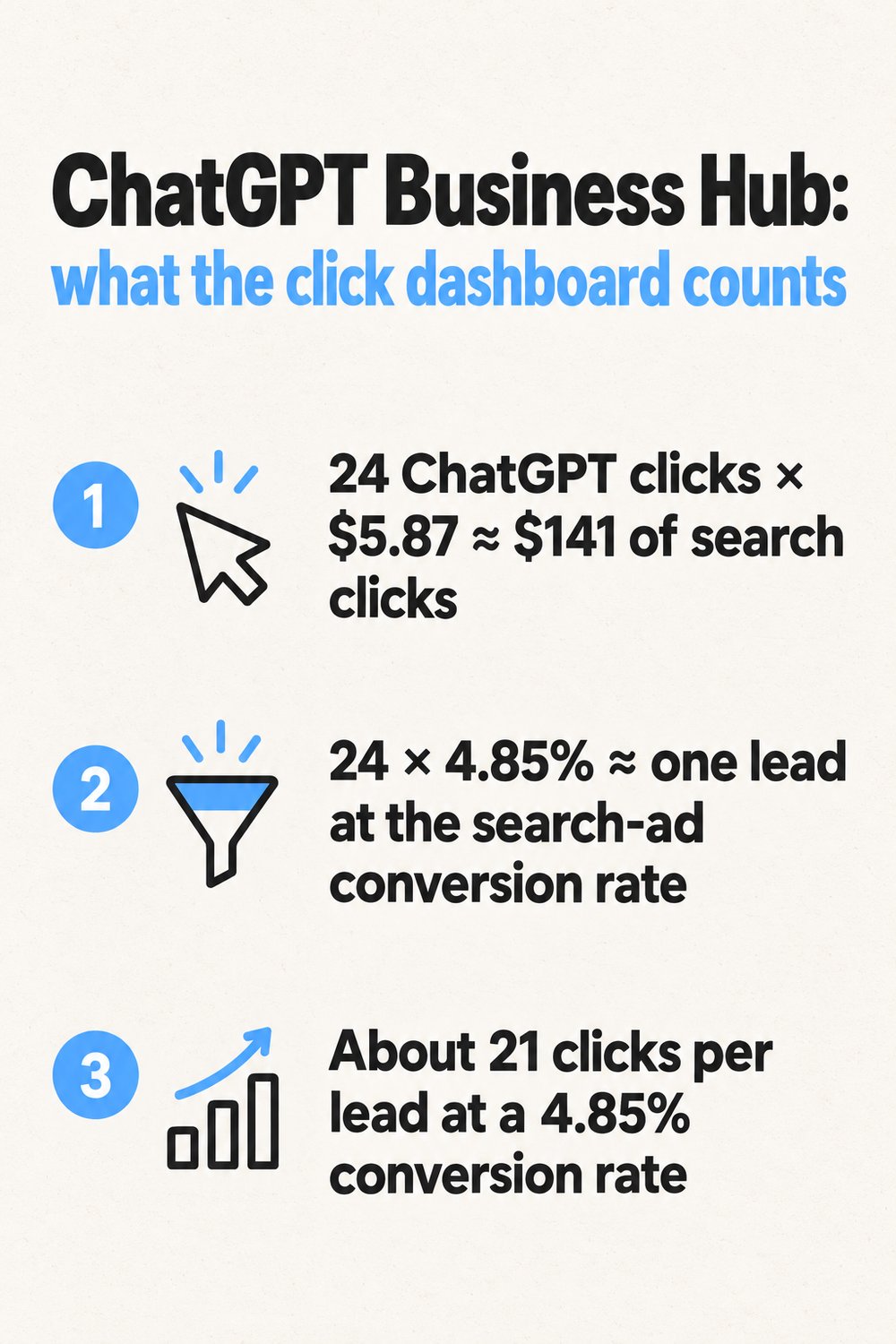
About $141 of search-ad clicks, and about one lead if they converted at the search-ad rate. That's the 24 clicks on the BuildUp Bookings dashboard, one of two small dashboards shared publicly at launch, as reported by PPC Land, priced with WordStream's 2026 Google Ads benchmark.
Cost per click (CPC) is the price an advertiser pays each time someone clicks a search ad. Conversion rate is the share of those clicks that turn into a lead or sign-up.
WordStream's 2026 benchmark covers 13,474 US search campaigns in Google Ads and Microsoft Ads, using medians. It has no software row. The closest, Business Services, sits at $5.87 per click and 4.85% conversion.
- 24 clicks × $5.87 ≈ $141 of search traffic in 28 days
- 24 × 4.85% ≈ 1.2, so about one lead
- 1 ÷ 4.85% ≈ 21 clicks for each lead at the search rate
- the second small dashboard, Zianvo, logged 1 click: 1 × $5.87 = $5.87
Treat those as rough sizing, not a ceiling or a forecast. A recorded click isn't a confirmed visit, and an answer click isn't an ad click on a keyword you picked. The sum sizes the channel. That's all.
So here's the honest read for a small team. On the small dashboards shared so far, ChatGPT Business Hub reports a trickle of organic clicks, and Business Agents, the chat a business can sponsor as a ChatGPT Ads destination, are limited for now to eligible US ecommerce and online service businesses. A search ad budget buys clicks by the day.
That's why Viewfy's agents run Google ads in your own ad account, with new creatives weekly and budget moved to what earns, while the AI-answer work builds underneath. If you're setting that up, start with which Google Ads channels a small SaaS should fund first.
Why not benchmark against OpenAI's demo or a big publisher?
Because neither is your site. OpenAI's fictional demo brand showed 15,356 mentions and 5,432 clicks over seven days, 5,432 ÷ 15,356 ≈ 35%. Neither of the two small live dashboards shared at launch came near that. Both work out to about 3.5%.
Search Engine Journal, a large publisher, reported 353,356 mentions and 2,663 clicks in the 28 days to November 10. That's 2,663 ÷ 353,356 ≈ 0.75%. BuildUp Bookings came in at 24 ÷ 690 ≈ 3.5%.
Pick the wrong one and you'll either panic or celebrate for no reason. Everything PR put it plainly: "Two dashboards are anecdotes, not a benchmark." Your ChatGPT Business Hub baseline is your own first screenshot.
How should you read ChatGPT Business Hub next to your analytics?
As a ratio, logged weekly, checked against what your own database says. Step by step:
- Screenshot the 28-day view the same morning each week, since the window keeps rolling.
- Divide clicks by mentions for your own click rate. Watch the trend, not the level.
- Put the clicks beside chatgpt.com referral visits in your analytics for the same 28 days. The gap is clicks your analytics didn't log as chatgpt.com visits: some never loaded, and some may have arrived without a referrer.
- Count trials from those referrals in your own database, the same way you'd judge ads by your database rather than a platform's report.
- Read a blank as possibly "under the threshold", not automatically as zero.
Dashboards disagree. One of them is yours. The signup table.
Does claiming your business change what ChatGPT answers?
No published rule says it does. OpenAI says only that "ChatGPT may use this information to answer customer questions", and PPC Land notes OpenAI "does not say that claiming changes how often a business is mentioned or ranked."
Claim it anyway. It's free, it fixes wrong details, and it gives you a count nobody had before November 10. Business Agents, the chat that sits on your profile, are "limited for now to eligible ecommerce and online service businesses in the United States", so check your eligibility before planning around one.
A dashboard reports. It doesn't ship. That's the gap we covered in Viewfy vs Outrank: both write and publish a blog for you, Outrank's homepage lists no fixes to your site's code, and Viewfy ships SEO fixes as a pull request you merge. Tracking how engines name you is half the job.
What raises the mention count, and who does that work?
Work that makes your site the page ChatGPT cites. Since a ChatGPT Business Hub mention only counts when the answer references your website, the goal is a site the engine can read and quote, plus your name on sites it already trusts.
Viewfy's agents do that work in your own accounts. They first check that the bots ChatGPT and Claude read with can reach your site at all.
A post goes up on your own domain every day, and schema, meta and sitemap fixes arrive as a pull request you merge, with app logic untouched. Editor pitches leave from your own address and wait in a queue until you approve, edit or skip them. Viewfy also asks your buying questions and tracks the visits that arrive, not a vanity score.
We guarantee live mentions on real sites, never what a chatbot will say. The free tier is 100 drafts with no card, and Pro, the full set of agents, starts with a call (current as of 2026-11-18). Paste your URL at viewfy.ai and the free dashboard finds the threads where buyers ask; once Pro is running, the 7am morning report tells you what shipped.
Frequently asked questions
- Can a software company claim a profile in ChatGPT Business Hub?
- OpenAI says any eligible business located where ChatGPT is available can claim through Business Hub, and eligibility depends on industry, location and its verification and integrity checks. At least one claim outside the US was waitlisted on launch day, so a software founder should try the claim and expect a review rather than assume either outcome.
- Why does my Business Hub dashboard show no numbers?
- Insights only appear when there are enough conversations or interactions to meet OpenAI's thresholds, and OpenAI has not published what those thresholds are. A blank tile doesn't always mean there was no activity: it can mean activity sits under the cutoff, and OpenAI doesn't say which it is. Keep checking your analytics for chatgpt.com referrals in the meantime.
- Does Business Hub show what Claude or Perplexity say about me?
- No. Business Hub reports ChatGPT only and does not cover other AI engines. Viewfy asks your buying questions, tracks who ChatGPT and Google name for them and the visits that actually arrive, so the number you judge is visits, not a score. For Claude and Perplexity, read their referrals in your own analytics, the same way each week.
- Does it cost anything to claim a business in ChatGPT?
- OpenAI's pages mention no fee for claiming a business or publishing a Business Agent. Sponsoring an agent falls under ChatGPT's paid ad formats, which are a separate decision. The real cost is the work that earns site-cited mentions: pages the engine can read, answers on your own domain, and mentions on sites the engine already trusts.
Keep reading
Google Ads channel prioritization for small SaaS
Google Ads channel prioritization starts every channel at High. Here's how a small SaaS sets priorities and caps against cost per trial before February.
· 6 min read
ChatGPT Sponsored Agents: can you buy a mention?
ChatGPT Sponsored Agents put a labeled ad chat beside the answer, not inside it. What a founder can buy, what stays unbought, and how to earn the mention.
· 6 min read
Viewfy vs Peec AI: AI visibility tracker or agents?
Viewfy vs Peec AI: Peec's new Actions rank fixes your team still publishes. Viewfy's agents ship the daily post, SEO PRs and pitches.
· 6 min read
Viewfy vs Profound: tracking AI answers vs acting
Viewfy vs Profound: one tracks how AI engines name your brand, the other ships the posts, crawler fixes and links that change the answer.
· 7 min read