SEO fixes pull request GitHub: what's worth merging
An SEO fixes pull request GitHub shows as a diff: which schema Google still uses in 2026, what to refuse, and how to review it fast.
 Mike Kovetskyi, Viewfy Founder6 min read
AI label.Generated with AI and published automatically. Images are AI-generated. Viewfy is responsible for this content. How AI content is marked

In short
An SEO fixes pull request worth merging carries only markup Google documents: gallery types like Organization, Article and Software app, plus WebSite on the homepage for your site name. Refuse lastmod that moves every build, oversized sitemaps and ratings nobody gave. Viewfy's agents open the pull request on a branch; you merge or close it.
The Google markup in an SEO fixes pull request GitHub opens should carry only what Google documents. Types from its 25 gallery features, plus WebSite markup on the homepage. Viewfy's agents open one and never push to main.
That's the part an agency usually hands you as a PDF. Then someone still has to ship it.
So a good pull request is mostly about what it leaves out.
What should an SEO fixes pull request GitHub opens contain?
Its Google markup should be only what Google's current documentation still uses, written into your site's templates, and its crawler fixes should match what a fetch as each crawler actually gets back. A pull request is a proposed change on a separate branch of your code that you review line by line before it goes live. Nothing reaches your site until you merge.
This is how Viewfy's agents do it, step by step:
- Viewfy installs as a GitHub App on the one repo you pick. No other repos.
- The agents work in a clone and open the pull request on a branch.
- They don't push to main, and they can't.
- App logic stays untouched.
- You review the diff and merge it, or you close it.
A sample pull request on our site lists three changes: "robots.txt no longer blocks the crawlers that quote you", "H1 answered in the first forty words" and "canonical and schema on the money pages". A canonical tag is a line in a page's head that names the main URL when several URLs show the same page.
 AI-generated image
Which schema still earns a feature in Google Search in 2026?
The types in Google's current gallery, plus WebSite markup on your homepage, which Google documents separately for site names. Schema markup is a block of code, usually JSON-LD, that tells search engines what a page is. An article, a product, an organization.
Markup makes a page eligible, nothing more. In Google's words, "The actual appearance in search results might be different."
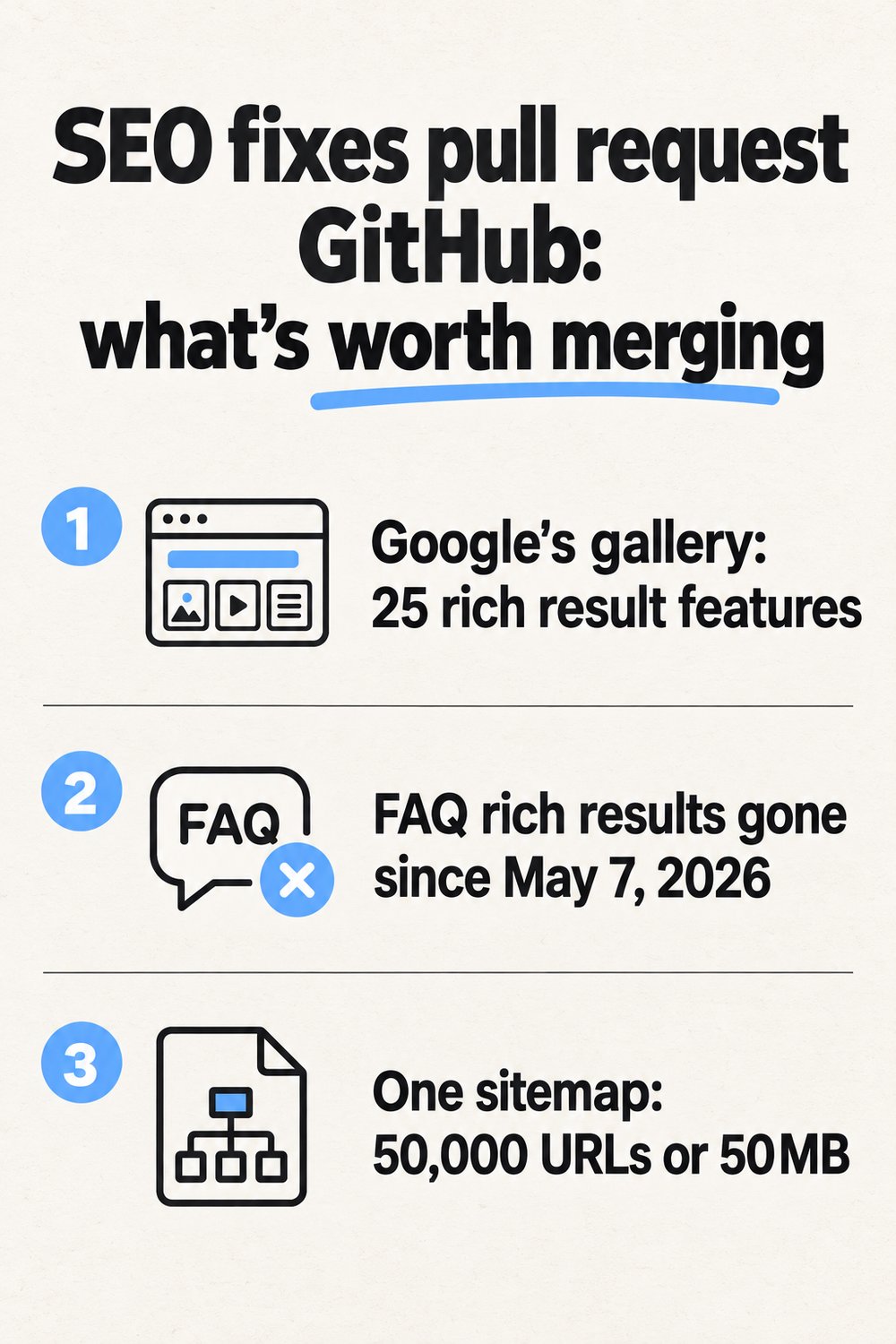
Google's search gallery lists 25 features today. FAQ and HowTo aren't among them. Site name isn't either, but Google's site names page still asks for WebSite markup on the home page, so keep that block.
For a SaaS site with a blog, the ones that usually have real content behind them:
- WebSite, on the homepage: name and url, to set the site name you'd like Google to show.
- Organization, on the homepage: your name, logo and URL.
- Article, on every blog post.
- Breadcrumb, on pages nested under a section like /blog. Google shows it in desktop results only.
- Software app, on the product or pricing page, if you have reviews.
- Video, on pages with a real demo video.
- Review snippet, with a catch. Testimonials about your own company marked up as Organization won't get stars. Google calls those pages ineligible when the company controls the reviews about itself. Fake or undisclosed incentivized reviews are out too.
Software app has the strictest requirements. Google requires name, offers.price (set to 0 for a free app) and either aggregateRating or review. No ratings yet? It can't earn the Software app result until real reviews exist, and a rating nobody gave breaks Google's guidelines.
| What Google documents | Value |
|---|---|
| Features in the structured data search gallery | 25 |
| FAQ rich result in Google Search | not shown since May 7, 2026 |
| FAQ rich result documentation | removed June 15, 2026 |
| Single sitemap limit | 50,000 URLs or 50MB uncompressed |
Which Google rules tell you what to refuse in an SEO fixes pull request GitHub opens?
Refuse any line Google's current documentation won't accept, can't verify or treats as a guideline breach. Three checks cover it:
- A `` that changes on every build. Google's sitemap guide says lastmod is used only when it's consistently and verifiably accurate, and a copyright date update doesn't count as a significant change.
- One sitemap file past 50,000 URLs or 50MB uncompressed. Google says a bigger one has to be split into several sitemaps.
- Software app markup with a rating nobody gave.
A sitemap over the limit has to be split before Google will take it. A rating nobody gave breaks Google's review guidelines and can bring a manual action. A lastmod that moves on every build only spends your review time on a line Google says it won't trust.
How do you review an SEO fixes pull request GitHub shows, step by step?
You review it in five checks, starting with the list of changed files and ending with the merge button.
- Check the files changed. Templates, the head component, robots.txt, the sitemap. Nothing in billing, auth or the API.
- Open the JSON-LD and compare each value to the page. Price, product name and logo URL should match what a visitor sees.
- Look at the sitemap. Count the URLs against the limit, and confirm lastmod only moves when the content did.
- Read the robots.txt diff line by line. A single Disallow can hide the whole site from a crawler.
- Merge, or close with a comment.
Compare that with briefing a developer on an audit PDF, then reviewing their pull request anyway.
Why do crawler fixes sometimes live outside the repo?
Because a CDN can block a crawler before robots.txt comes into it. Cloudflare's AI Crawler and Agent access policies can block AI crawlers at Cloudflare's edge, even when your robots.txt lets them in. A pull request can't flip that switch.
So the agents check whether the crawlers ChatGPT and Claude read with can reach your site at all. They request your site as each crawler and compare the answer against a control fetch. Each named AI crawler gets checked against your robots.txt on its own. If the block sits in Cloudflare, that's a setting you change in Cloudflare, and the repo stays as it is.
That gap between spotting a block and fixing it is the difference between tracking AI answers and acting on them.
What does the pull request replace on an agency invoice?
It replaces the technical SEO line: the audit, the ticket and the back-and-forth with your developer. With an SEO fixes pull request GitHub hands you, the review is the only step left on your side. Viewfy Pro puts that line next to the rest of what an agency bills for.
Meta and Google ads with the creatives, a daily blog, links from pitches you approve. On the ads side, which Google Ads channels a small SaaS should fund first is its own read.
The daily post publishes on your own domain with your colors, logo and search markup, so the Article schema arrives with it. If you're weighing blog tools, how Viewfy and Outrank differ on posts and fixes goes deeper.
One morning message at 7am tells you what the agents shipped, including the pull request waiting for you.
Which plan gets you the pull request?
Viewfy Pro. The pricing page says Pro "is priced on a call with the founder", and the plan covers ads, the daily blog, SEO fixes and links. Prices are current as of 2026-11-13. The cheaper Mini plans ($29/mo and $49/mo) are reply drafting tools and don't include SEO fixes.
Merge what's real, close what isn't. Run the free AI crawler check at viewfy.ai/check-seo-geo with no account. Or book the Pro call at viewfy.ai, and your first SEO fixes pull request GitHub shows you arrives as a branch you can read before anything changes.
Frequently asked questions
- Does merging an SEO pull request change how my app works?
- It shouldn't. Viewfy's SEO fixes arrive as a pull request with app logic untouched, on a branch the agents open in a clone of the one repo you picked. They can't push to main. If a file in billing, auth or your API shows up in the diff, close the pull request and nothing reaches your site.
- Should I delete the FAQ schema already on my site?
- Google stopped showing FAQ rich results on May 7, 2026 and removed the documentation on June 15, 2026, so new FAQPage markup won't win a rich result. Keep the visible FAQ on the page for readers. Just don't count on the markup for anything in Google's results.
- What does Software app schema need for a free SaaS tool?
- Google requires name, offers.price set to 0 for a free app, and either aggregateRating or review. Recommended extras are applicationCategory, such as BusinessApplication, and operatingSystem. If you don't have real ratings or reviews yet, this markup can't earn the rich result, so never fill the gap with a rating nobody gave. Organization and Article markup still apply.
- Can a pull request fix a Cloudflare setting that blocks AI crawlers?
- No. Cloudflare's AI Crawler and Agent access policies can block AI crawlers at Cloudflare's edge whatever your robots.txt says, and they live in your Cloudflare dashboard, outside the repo. Viewfy's agents request your site as each crawler and compare the answer with a control fetch, so you see the block. Flipping the setting is your call.
Keep reading
Viewfy vs Profound: tracking AI answers vs acting
Viewfy vs Profound: one tracks how AI engines name your brand, the other ships the posts, crawler fixes and links that change the answer.
· 7 min read
Marketing for solo founders without an agency retainer
Marketing for solo founders without a retainer: Viewfy's agents run ads, a daily blog, SEO fixes and pitches. Start with 100 free drafts.
· 6 min read
AI agents for marketing that ship the work
AI agents for marketing should ship the work: ads in your own account, a daily post on your domain, SEO fixes as pull requests. Here's how Viewfy does it.
· 5 min read
Replace marketing agency with AI: what goes first
How to replace marketing agency with AI: give Viewfy weekly ad creatives, the daily post and SEO pull requests first, and keep approval over every reply.
· 5 min read