Meta pixel: measure conversions on customer devices
Meta pixel's Measure conversions on customer devices rolls out November 12. Record your trial ratio first and judge ads by your database.
 Mike Kovetskyi, Viewfy Founder8 min read
AI label.Generated with AI and published automatically. Images are AI-generated. Viewfy is responsible for this content. How AI content is marked

In short
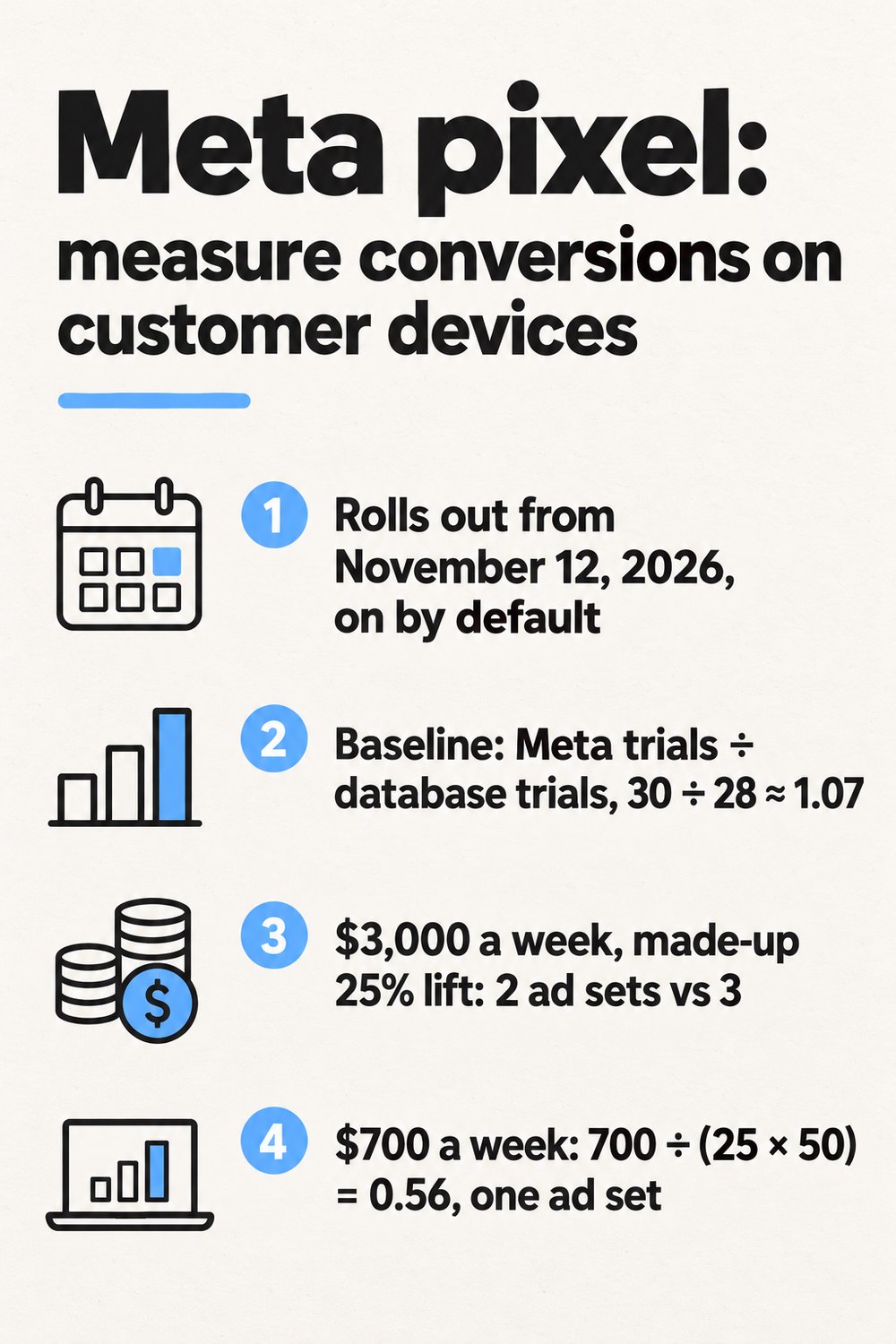
Keep the Meta pixel setting Measure conversions on customer devices on. It rolls out from November 12, 2026, outside the EU and UK, and Meta hasn't said whether SaaS trials count. Record Meta trials ÷ database trials and size ad sets on database cost per trial: with a made-up 25% lift, $3,000 a week is 2 ad sets, not 3.
Meta's pixel setting "Measure conversions on customer devices" starts rolling out November 12, 2026, on by default.
A SaaS with email login meets the login condition, if its pixel sits directly on the page, though Meta describes the feature for purchases and hasn't said whether trials, or visitors who haven't logged in yet, count.
Viewfy's advice.
Keep it on, record today's trial ratio, judge ads by your database.
If your trial event is covered, Meta could report more trials. Your database won't. That gap can change how many ad sets your budget carries.
At $3,000 a week, a made-up 25% lift in Meta's count would turn two ad sets into three. A $700 budget gets one either way. You can measure the gap before the switch flips.
What does measure conversions on customer devices change for a SaaS?
Meta adds a second place where it matches a sign-up to an ad. The customer's own phone or laptop. The settings panel says: "With this feature on, that measurement happens on your customer's device instead of exclusively on Meta servers." Server matching stays, and a device path joins it.
The match uses information the customer already gave you, such as an email address, plus "temporary, non-identifying device information". Meta then learns that a conversion happened and which campaign gets the credit. Meta also says the attribution window and attribution model stay as they are. An attribution window is a time limit that decides how long after a click or view Meta can still credit an ad with a conversion.
For a SaaS whose trial event is covered, this means the same trials, more of them credited to ads. Cost per trial is a paid ads metric that divides spend by the trials the ads brought in. Same spend, more credited trials. So the reported cost per trial drops while the rows in your users table stay where they were.
 AI-generated image
Does my SaaS qualify for measure conversions on customer devices?
Probably, if people log in and the pixel sits directly on the page. Meta's help pages, as summarized in PPC Land's write-up, set two conditions and one place where the feature stays dark:
- The pixel sits directly on the page, not "inside an iframe or as an image-only (img) pixel".
- The site requires users to log in with an email address or a mobile phone number.
- The feature "is not active for people located in the EU and UK".
A product with a sign-in meets condition 2. A waitlist page that only collects an email, with nothing to log into, reads as outside it. Check condition 1 on the page where sign-up completes. A sign-up form embedded through a frame from another tool is the iframe case.
Meta's help pages also don't say what happens for a visitor who hasn't logged in yet, and that's where every trial sign-up starts.
If part of your trials come from the EU or UK, measure conversions on customer devices leaves them alone and they count the old way. Your ratio will move only on the rest.
| Fact | What Meta's pages and the panel say |
|---|---|
| Start | Panel line: "Measurement starting November 12, 2026" |
| Default | On for eligible pixels, can be switched off any time |
| Who qualifies | Pixel directly on the page, users log in with email or phone |
| Where it is off | People located in the EU and UK |
| What Meta receives | That a conversion happened and which campaign gets credit |
| Pixel and Conversions API | It complements them and replaces neither |
Should a SaaS keep measure conversions on customer devices switched on?
Yes. Switching it off doesn't change who signs up today. It changes how many of them Meta sees, and possibly what Meta's delivery learns from, which Meta hasn't spelled out. Meta says the setting is there to "improve campaign performance with a stronger signal".
Yiqi Wu, CEO of Aimerce, which builds pixels for Shopify stores, wrote about store purchases: "I wouldn't opt out by default." His exception is to opt out "if your numbers stop matching the orders and you can't figure out why."
Meta hasn't said whether the recovered trials feed bidding or only the reports. So keep it on, and stop reading Ads Manager as the scoreboard.
If you do want it off, it's per pixel. Events Manager, then Data sources, then your pixel, then Settings, where the toggle sits under the Meta Pixel settings section.
What should I write down before November 12?
A baseline ratio. Meta-reported trials divided by the trials in your own database for the same weeks. A SaaS has an advantage here. Every trial is already a row with a sign-up date and an email, so the second number needs no store export.
- Pick the last four full weeks.
- Count database sign-ups whose first visit came from a Meta ad, by UTM source or however your app tags the source.
- Pull Meta's reported count for the trial event your ad set optimizes for, same weeks.
- Divide Meta's number by the database number. Say Meta shows 30 and the database shows 28: 30 ÷ 28 ≈ 1.07.
- Divide spend by the database trials too. That's your cost per trial by your own count, a number Meta's settings can't move, and it's the figure you keep using after November 12.
- Repeat steps 2 to 5 every week after November 12. If the ratio climbs while database trials hold and you changed no ads, budgets or tracking, that gap is most likely measure conversions on customer devices at work, and no ad got better.
Suppose Meta shows 36 trials a few weeks later against the same 28 in the database, 36 ÷ 28 ≈ 1.29. Nothing improved except the report.
How many ad sets can a small SaaS budget support now?
Run Meta's ad-set formula twice, once on database cost per trial and once on Meta's, and a $3,000 weekly budget comes out at two ad sets versus three. At $700 a week it's one ad set either way, so the setting leaves a founder-sized structure alone.
The formula is the one from Meta's October 21 post, "Total weekly budget ÷ (cost per result × 50) = the most ad sets your budget can support" (PPC Land covered it). The 50 comes from the learning phase. The learning phase is the stretch after a new ad set or a big edit when Meta's delivery system is still testing who to show ads to, and it usually ends after about 50 results in a week.
The 25% lift below is a made-up number for the sum, nothing more.
A SaaS spending $3,000 a week with 120 database trials pays 3,000 ÷ 120 = $25 per trial. The formula gives 3,000 ÷ (25 × 50) = 2.4, so two ad sets. If Meta reports 150 trials for the same week (150 ÷ 120 = 1.25), the reported cost is 3,000 ÷ 150 = $20, and the formula gives 3,000 ÷ (20 × 50) = 3.
That third ad set rests on 30 trials Meta credits to ads that your own UTM count doesn't. If Meta's delivery learns from those recovered trials, they count toward the 50 and three ad sets can exit learning. Meta hasn't said whether they do, so plan on two until your weekly ratio and database trials show the third one paying its way.
At founder budgets the answer doesn't move. A team spending $700 a week with 28 trials pays 700 ÷ 28 = $25 each, and 700 ÷ (25 × 50) = 0.56. Even the inflated $20 gives 700 ÷ (20 × 50) = 0.7. One ad set, every creative inside it.
One caveat. Meta's own examples talk about purchases, and we haven't seen Meta confirm that a sign-up or lead event is covered, so a SaaS trial event might not move at all. That's what the weekly ratio tells you.
How do I judge ads, Viewfy's included, after November 12?
By database trials per dollar, week over week. If your trial event is covered, Ads Manager's number could flatter ads from November 12 on, including the ones Viewfy's agents run.
Before the first ad, the agents read the paid ads every rival is running. New creatives ship every week, the ads that don't earn are paused, and their budget moves to the ones that do. Every change lands on the ads board, and one morning message at 7am says what shipped.
Put that board next to your weekly database count and you can see which move brought real sign-ups. For what an agent running the ads does that Meta's own assistant doesn't, see Meta's AI assistant next to an ads agency.
This setting touches the Meta pixel only. A Google Ads cost per trial isn't moved by it, which makes Google a fair second yardstick for a team that runs both, as in our Google Ads guide for small SaaS.
What else has Meta changed for advertisers this year?
Two other changes are worth a look this year: one on the same screen, one in Meta's terms. In April Meta added the AI toggle "Automatically include more detailed page and product info", which sits just above the measure conversions on customer devices toggle in the pixel panel. And the new commercial terms put advertisers on the hook for Meta's AI edits to their ads, covered in Meta Commercial Terms: you own its AI ad edits.
Each one changes what Meta does with your account without you touching an ad. Read Events Manager settings once a month.
Where does an agency fit in this?
An agency bills a retainer for running your ads and reporting back. Viewfy's agents do that work and send one morning message at 7am with what shipped. For the wider case on running growth without a retainer, see marketing for solo founders. Viewfy Pro, the agents that do your agency's work, starts with a call on viewfy.ai.
Frequently asked questions
- Does the new pixel setting count sign-ups from EU and UK visitors?
- No. Meta says the feature is not active for people located in the EU and UK. Trials from those visitors keep counting the old way, so if a large share of your sign-ups come from there, your ratio of Meta-reported trials to database trials will move less than it does for a team selling mostly elsewhere.
- Do I need to change my Conversions API setup for this?
- No. Meta describes the feature as working alongside the pixel and the Conversions API, replacing neither, and Stape notes you do not need a new Conversions API integration for it. Keep server-side events running as they are. The new setting needs the browser pixel placed directly on the page, so a setup without it will likely see no change.
- Does Meta get my users' email addresses through this setting?
- Meta says the match runs on the customer's device using information they already shared with you, such as an email, plus temporary, non-identifying device information. According to Meta, the identifying information used for the match is not sent to Meta. What Meta receives is that a conversion happened and which campaign gets the credit.
- Will a waitlist page or a demo form without login be affected?
- Probably not. One of the two conditions Meta sets is that the site requires users to log in with an email address or a mobile phone number. A page that only collects an email with nothing to log into reads as outside that condition, while a product with a sign-in meets it, provided the pixel is not inside an iframe.
Keep reading
Meta Commercial Terms: you own its AI ad edits
The new Meta Commercial Terms make advertisers solely responsible for AI edits in their ads. Here's what changed and how to switch off Meta's own changes.
· 5 min read
Google Ads channel prioritization for small SaaS
Google Ads channel prioritization starts every channel at High. Here's how a small SaaS sets priorities and caps against cost per trial before February.
· 6 min read
Meta AI business assistant vs your ads agency
The Meta AI business assistant tests campaign, creative and budget changes by chat. Why it covers Meta only, and how Viewfy runs the rest of the agency's work.
· 6 min read
Viewfy vs a growth agency: when to use which
When Viewfy beats a growth agency: he finds the thread and drafts the reply, you approve. Hire an agency when you need humans owning strategy and a big budget.
· 5 min read