AI ad creative generator vs agents that run the ads
An AI ad creative generator hands you files. Viewfy reads rivals' running ads, makes fresh creatives weekly and runs them in your own Meta and Google account.
 Mike Kovetskyi, Viewfy Founder5 min read
AI label.Generated with AI and published automatically. Images are AI-generated. Viewfy is responsible for this content. How AI content is marked
In short
An AI ad creative generator gives a founder files, but someone still has to pick the message, run the ads and replace them every week. Viewfy's agents read every rival's running paid ads first, make fresh creatives every week and run them in the founder's own Meta and Google ad account, with every change on the ads board.
An AI ad creative generator gives you image and video files. Viewfy's agents decide what to make from a read of rivals' running ads, then run the creatives in your own Meta and Google ad account, fresh every week.
Files are the easy part. The work an agency bills for sits around them. Picking the message, putting money behind it, swapping it out when it stops earning users, and telling you what changed.
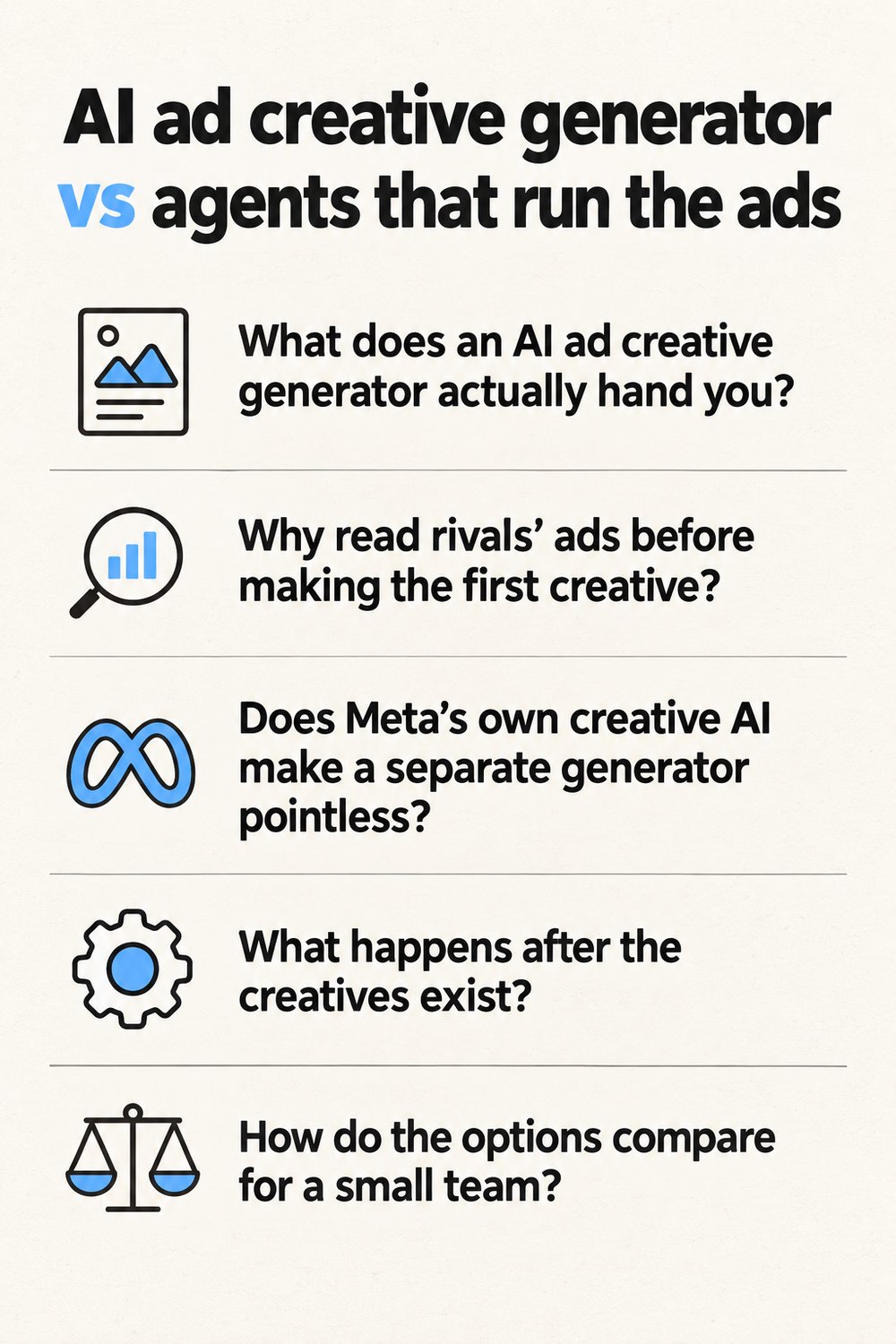
What does an AI ad creative generator actually hand you?
A folder of assets. You type a prompt or upload a product shot, and the tool returns images, short videos or copy variations sized for the placements you chose.
That saves design hours, and for a founder with no designer, design hours matter. What the folder doesn't contain is any reason to believe a variation will earn a trial. Somebody still has to open the ad account, set a budget, launch, wait, read the numbers and pull the losers. Usually that somebody is you.
 AI-generated image
Why read rivals' ads before making the first creative?
Because your rivals have already paid to test messages in front of your buyers. The ads they keep funding show you which offers held up.
Before the first ad, Viewfy's agents read the paid ads every rival is running. That read sits next to what buyers search and what they ask ChatGPT, and every creative starts from it. A generator starts from your prompt. Your prompt starts from a guess.
How that read feeds a Meta account week to week is in our Meta ads guide for startups.
Does Meta's own creative AI make a separate generator pointless?
On Meta placements, it covers a lot of what a generator does. On October 6, 2026, at Advertising Week New York, Meta said advertisers and agencies can now generate video from existing static assets in Advantage+ creative, and that the feature is generally available (Meta's announcement). Advantage+ creative is a Meta Ads Manager feature that uses AI to produce variations of the assets you upload.
Meta also started a broader rollout of Ads Creative Studio. Ads Creative Studio is a Meta tool that generates and edits video variations, down to the hook, captions, audio length and ending scene. A small team already on Meta now has a creative generator inside the account.
Two things it leaves alone. Meta's tools vary what you hand them, so the message still comes from you. And they stop at Meta's edge, so your Google search ads need their own plan. The Meta AI business assistant has the same border.
What happens after the creatives exist?
Someone has to run them, decide which one gets the money and replace them next week. Most generators stop before that part. Viewfy's agents start there, and the loop repeats every week:
- Read the paid ads every rival is running, plus what buyers search and ask ChatGPT.
- Make the week's fresh creatives from that read.
- Run them in your own Meta and Google ad account.
- Put every change on the ads board.
- Move budget toward the ads that earn users.
- Report what shipped in one morning message at 7am.
The ads board is Viewfy's record of every change the agents make in your ad account. When a cost moves, you can see what changed just before it.
Google now has a native control for which campaign types get budget first. We walked through it in Google Ads channel prioritization for small SaaS.
How do the options compare for a small team?
They split on two questions: who decides what to make, and who runs it once it exists. Here's how four common setups divide that work.
| Option | What decides the creative | Who runs the ads | Where it works | What else ships |
|---|---|---|---|---|
| Viewfy's agents | A read of rivals' running ads and buyer searches, redone weekly | The agents, in your own ad account, every change on the ads board | Meta and Google | Daily post, SEO pull request, editor pitches |
| Standalone AI ad creative generator | Your prompt or upload | You | Wherever you upload the files | Files only |
| Meta's built-in creative AI | Assets you upload | You, plus Meta's delivery system | Meta only | Nothing outside Meta |
| Marketing agency | The retainer scope | Agency staff | Per contract | Per contract |
How do you judge whether the creatives work?
By cost per trial or install. How good the image looks doesn't enter into it. Cost per trial is a paid-ads metric that divides ad spend by the number of trials those ads produced.
Clicks and reach are inputs. A pretty creative with a high cost per trial is a loss with good lighting. Because the ads run in your own account, the numbers sit where you can check them without asking anyone, and the history stays yours.
One more test, and a folder of files can't pass it alone: is next week's set different from this week's? A rotation needs someone to keep it turning. The agents ship a fresh set every week whether or not you remember to ask.
What should a founder hand to the agents first?
If ads are the line you'd otherwise pay an agency for, start with ads. That means the rival read, the weekly creatives and the budget moves. Our guide to what goes first covers the order for the rest of the plan.
Ads aren't the whole job. The same agents publish a post a day on your domain, ship SEO fixes as a pull request you merge, and draft editor pitches that wait in a queue until you approve, edit or skip them. More on that split in AI agents for marketing that ship the work.
| What | How Viewfy's ads agents handle it |
|---|---|
| Before the first ad | The paid ads every rival is running are read |
| Creatives | A fresh set every week |
| Where ads run | Your own Meta and Google ad account |
| Record of changes | Every change on the ads board |
| Report | One morning message at 7am |
| Plan with ads | Viewfy Pro, which starts with a call |
Details current as of 2026-10-19. Ads work is part of Viewfy Pro, the full growth agent, which starts with a call at viewfy.ai. Even then, the first ad waits until every rival's running ads have been read. Viewfy gets you users while you ship.
Frequently asked questions
- Do the ads run in Viewfy's ad account or mine?
- Yours. Viewfy's agents run Meta and Google ads in your own ad account, and every change they make goes on the ads board. The account, its history and its settings stay with you, so you can open Ads Manager or Google Ads any time and see what's running and what it costs without asking anyone for a report.
- Can I use Viewfy for ads if my product isn't live yet?
- Not yet. The agents start every move from a read of the market and your live site: rivals, their paid ads, what buyers search and what they ask ChatGPT. With nothing shipped there's no site to read and no trial to count. Launch first, then bring the agents in once an ad has somewhere to send people.
- Is there a free way to try Viewfy before committing to ads?
- Partly. The free tier gives 100 drafts with no card, shared between the dashboard and the Chrome extension, and you can paste your URL to see which threads Viewfy finds. Ads work is part of Viewfy Pro, the full growth agent, which starts with a call. Plan details are current as of 2026-10-19.
- Will AI-made creatives read like every other AI ad?
- They start from a different place. Each week's creatives come from a read of what rivals already run, so the agents know which angles are crowded before writing yours. Copy also goes through a hard refusal list for AI-sounding writing, which rules out em dashes, a list of tired filler words and recycled year-trend lines.
Keep reading
Google Ads management for SaaS, run by AI agents
Google Ads management for SaaS by Viewfy's agents: rivals' ads read first, new creatives weekly, budget moved to what earns, in your own Google Ads account.
· 5 min read
Meta ads management for startups without a retainer
Meta ads management for startups without a retainer: Viewfy reads rivals' ads first, ships fresh creatives weekly and runs Meta ads in your own ad account.
· 5 min read
Google Ads channel prioritization for small SaaS
Google Ads channel prioritization starts every channel at High. Here's how a small SaaS sets priorities and caps against cost per trial before February.
· 6 min read
Meta Commercial Terms: you own its AI ad edits
The new Meta Commercial Terms make advertisers solely responsible for AI edits in their ads. Here's what changed and how to switch off Meta's own changes.
· 5 min read